Perkʷū́nos
Perkʷū́nos (either "Striker" or “Oak God”) is the god of thunder and lightning. His greatest myth is slaying the Great Serpent, manifestation of Chaos. As the mighty champion, he is a god of war, particularly against outside dangers and in defense of his people. As god of the thunderstorm, he is also a patron of farmers, and therefore connected with fertility, especially of crops. Other things connected with him, as will become clear, are gluttony, wheels, pillars, oaks, mountains, bulls, and goats. Above all, his reflexes are armed with a club, axe, and/or aerial weapon, which he throws.
Perkʷū́nos survived by name in Albania (Perëndi (“god,” “sky”) (Jakobson, 1972, 6)), Thrace (basically the area of modern Bulgaria) (Perkos), India (Vedic Parjanya and the Kush war god Pērūne (Jackson, 2002, 76, n. 25)), and Anatolia (Pirwa (Gamkrelidze and Ivanov, 1995, 694) and Peruna (Jakobson; 1969; 588, 593)). The name might also underlie Greek Keraunós “thunderbolt,” which appears as a title of Zeus, if that is a tabu-variant of *Peraunós (Jakobson, 1972, 6). His worship under a name descended from *Perkʷū́nos survived best among the Balts and Slavs; among the Lithuanians, he was called Perkunas (variably, Perū́nas (Jakobson, 1972, 5), and in early texts, Percunus, Percunos, Pirchunos, Perkuns, Parcuns, or Pargnus (West, 2007, 239)), among the Latvians Perkons, among the Old Prussians Percuno(s) (Turville-Petre, 1964, 97), and among the Slavs Perúnъ (Old Russian Perunu, Belorussion Piarun, Slovak Parom). These Balto-Slavic reflexes were extremely popular; hundreds of places are named after him among the Balts alone (Gimbutas, 1973, 466). These include villages (Lithuanian, e.g., Perkūnai, Perkūniškiai, Slavic Perun), hills (e.g., Lithuanian Perkūnkalnis, Slavic Perushtitsa), and rivers (Lithuanian e.g., Perkūnija) (Gimbutas, 1973, 467).
In some of the descendant traditions his name comes from one of his titles, the Thunderer. Thus we have the Armenian Tork’ (Russell, 1990, 2680), Anatolian Tarrḫunda/Tarhunt (Russell, 1990, 2689; Matasovič, 2009), Norse Thor and Saxon Thunor (<*Thunaraz) and Celtic Taranis (variant Tanarus), all from *TorH2nt- (Matasoviç, 2009), from *(s)tenH2- “thunder” (Jackson, 2002, 77), giving a possible Proto-Indo-European alternate name of Torxṇts. The Hittite storm god Tarḫunnaš (variants Tarhunna, Tarnunta, Tarawa), whose name has been assigned the meaning “vanquisher, smasher,” from *torh- “conquer, vanquish” (Anderson, 2008, 279; Jakobson, 1969, 588) or *terH2- “idem” (Jackson, 2002, 77) may belong to this group as well. Perun is sometimes called Gromovnik, “Thunder God” (Kropej, 2003, 121). Parjanya receives the title stanayitnú- “Thunderer”(Jackson, 2002, 77). There was a temple to Jupiter Tonans, “Thunderer,” on the Roman Capitol (Johnson, 1958, 65).
Reflexes with unrelated names include the Celtic deity known in Gaul, Ireland, and Wales Lugos, Lug, and Lleu (Old Welsh Lau (Koch and Fernández, 2017, 52)), respectively (etymology uncertain), the Greek/Roman Herakles/Hercules (“Glory of Hera” or possibly “Famed for Strength” (Mallory and Adams, 117, 1997)), and the Roman Mars (of unknown etymology). And of course there is the most famous Indo-European dragon-slayer of all, the Vedic Indra (possibly “one swollen with power“ (Mallory and Adams, 1997, 561)). The Irish god “the Dagda” (“The Good God”) also falls into this group; in Tochmarc Étaine he is said to control the weather (Sayers, 1982, 356). He further has by-names such as reo (“dense darkness; throw, cast”), oíbell (“spark of flame), and áith “sharp, keen” (Sayer, 1982, 345). Another, however, Cerrce, may come from *perkʷ- (Sayers, 1982, 345-6). In Armenian epic, Sanasar is the hero who uses his “lightning sword” to kill a dragon. His mother is named Covinar, which means “lightning,” who sometimes disguises herself as a man (Petrosyan, 2017, 172).
Other names by which Perkʷū́nos might be called in modern prayers today (they aren’t reconstructed for him) are *Koryonos, “god of the warband” (*koryos, in Mallory and Adams, 1997, 30-1), Ḱerdhos (with the same meaning) (Weiss, 2017, 374), and Ḱówṛs *ḱóuh1r-), “Powerful One, Hero” (Mallory and Adams, 1997, 560).
The Baltic god Perkūnas (and other versions of this Baltic god) was connected with oaks, such as in a Latvian daina in which he’s said to strike an oak, cleaving it (Zaroff, 2019, 199). There were oaks (but also sorb trees) dedicated to Perkūnas in Samogitia attested in the 17th century (Zaroff, 2019, 200).
The thunder god was extremely popular. Indra is the most commonly mentioned god in the Rig Veda. Herakles/Hercules was worshiped all over Greece, and even beyond (Burker, 1979, 78).
The myth of Perkʷū́nos slaying a great serpent is the best-reconstructed Proto-Indo-European myth, surviving in many reflexes. Perkunas killed the dragon Áitvaras (West, 2007, 240). Indra killed a number of serpents/demons, the most famous being Vṛtra, a myth told many times (for instance RV 1.32; see O’Flaherty, 1975, 74-90 for examples). Herakles killed the multi-headed Hydra (Apollodorus, 2.5), the serpent of the Hesperides, and the serpents sent to kill him in the cradle. In the dindshenchas of Mag Muirthemne, the Dagda kills some kind of underwater monster with his “thunder-club” (lorg anfaidh; Gwynn, 1924, 4:295, translates it “mace of wrath,” but “thunder-club” is equally legitimate, and I think more likely). Thor is in constant opposition to the Midgard Serpent. Thor will kill and be killed by him in the final battle of Ragnarøk (Snorri, “Gylfaginning” 51). He fishes the serpent up and brings his hammer down on his head, but the serpent escapes (“Hymiskviða” 21-24, Hollander, 1962). In an early version, related by the tenth century Úlf Uggason, Thor killed the serpent some time before Ragnarøk (Turville-Petre, 1964, 76). The tale of their battle is also represented in stone reliefs (Stone, 1999, 17; Turville-Petre, 1964, 76). One of the panels of the Gundestrup cauldron, a silver-gilt work of art created in the Balkans or northeastern Italy but transported to and discovered in Gundestrup, Denmark, shows a deity holding a wheel, the symbol of the Gaulish Taranis. At the bottom of the panel is a ram-headed serpent. In eastern Gaul and western Germany we find the Jupiter columns, with their snake-spearing (or snake with men’s heads or upper bodies-spearing) Jupiters (note how in this last one the Jupiter figure has Taranis’ wheel on his shoulder) on top. Since the snakes sometimes have human heads, the columns may be meant to depict the fight with the semi-serpentine Typhoeus, but these columns are found only in this limited Celtic area, so they most likely represent something which was found in Celtic myth, represented in a classical form. Note that in these cases we are dealing with Jupiter the thunder and lightning god, not the reflex of Dyḗus Ptḗr. This myth may have survived into Christian times in the legend of St. George killing a dragon, represented in art in a form strikingly similar to that of the Jupiter columns.
In Albania, there is a monster called bolla, a term otherwise used for grass snakes (which are positive figures in both the Balkans and the Baltic regions), which on St. George’s Day (April 23) opens its eyes and eats whomever it sees. It was originally defeated by St. George (who hunts in the mountains (Elsie, 2001,100)), and cursed to be only able to open its eyes on this day (Elsie, 2001, 47). The dragon kulshedra, who guards the Earthly, Sea, and Heavenly Beauties, is a form of this dragon. She is defeated by St. Elias, who comes riding on his white horse or chariot of fire to kill her with thunderbolts (Elsie, 2001, 83). Her approach is accompanied by rain clouds. Churches dedicated to St. Elias are usually on hill tops (Elsie, 2001, 84).
The dragon-slayer is often accompanied by a human helper. Thus, Indra is helped in the killing of Trisiras by Trita Āptya (RV10.8). He returns the favor by helping Trita kill the serpent Viśvarūpa (West, 2007, 260), cutting off the snake’s heads. Herakles is helped to kill the Hydra by Iolaos (Hesiod, Theogony, 313-18). The Ukrainian dragon-slaying god is helped by a smith, although he is also a god (West, 2007, 259). The wheel on the Gundestrup cauldron is held up by a smaller figure, almost certainly meant to be a human rather than a deity. The reverse is the case with the Iranian Θraētaona, who kills the serpent Aži Dahāka with the help of the storm-god Vāyu (Mallory and Adams, 1997, 138).
The serpent often has multiple heads, usually three, or is multiple is some other way. The hydra, for instance, is shown in Greek art with a varying number of heads (see, e.g., Kron, 1998, 1991, figs. 1 and 2), although the canonical number is nine (Apollodorus 2.5.2, Hyginus 30). The serpent of the Hesperides had a hundred heads (Apollodorus 2.5.11), Trisiras has three, the kulshedra has seven to twelve (or nine tongues (West, 2007, 259)), Viśvarūpa three heads (RV 10.8.9; West, 2007, 260), and Aži Dahāka has three heads (Mallory and Adams, 1997, 138). There were two snakes killed by Herakles in his crib (Apollodorus 2.4.8, Hyginus 30). Geryon, a monster in mostly human form who was killed by Herakles, had three bodies (Apollodorus 2.5.10; Pausanias 5.19.1), joined at the waist, giving him three heads (Carpenter, 1991, fig. 201; Graves, 1965, 132) (or three bodies from the waist down, which would have meant he only had one head (Apollodorus, 2.5.10). (Geryon was the son of Chrysaor, who sprang from the neck of the decapitated Medusa, who had snakes for hair (Hesiod, Theogony, 280-93).) Thor is once called “cleaver of the nine heads of Þrívaldi” (Snorri, “Skáldskaparmál 4”; Lindow, 1988, 120).
The serpent is also connected with water in some way. The Midgard Serpent surrounds the earth in the waters. In “Skáldskaparmál” (Snorri, Epilogue 2) the Serpent is called “the water-soaked earth-band” against which Thor will “test his strength.” It is in the world-surrounding sea (Snorri, “Gylfaginning,” 34), and is called “Fiorgyn’s eel” (Snorri, Epilogue 57). We have seen how Thor fishes the serpent up from the sea. Geryon lives in “sea-girt Erythea” (Hesiod, Theogony, 290) and his mother was a daughter of Ocean (Apollodorus 2.5.10); the Hydra (“water”) lives in a swamp (Apollodorus 2.5.2); and the serpent of the Hesperides lives next to the ocean. The monster which the Dagda defeats is at the bottom of the sea. Vṛtra lays around (parisayānam) the waters, withholding them; Indra is “conquering in the waters” (Macdonell, 1897, 59). “Kulshedra” comes from the Greek kersúdros, “amphibious snake” (Elias, 2001, 153) and can turn herself into an eel, a turtle, a frog, or a salamander (Elias, 2001, 155), all water animals. She lives beneath a lake or a swamp, and rust-colored springs are believed to contain her blood; one way she kills people is by drowning them in her milk or urine (Elias, 2001, 155). She can cause wells to run dry, being appeased only by a human sacrifice (Elias, 2001, 155). In Albania, dead snakes were used in rain magic (Elias, 2001, 215). I think we are seeing here the connection between water and Chaos, of which the serpent is a representation.
Alternatively, the serpent might be guarding either women or cows (sometimes identified with each other). The Albanian kulshedra, guarding the three Beauties, is an example of this. Geryon guards cattle (Apollodorus 2.5.10; Hesiod, Theogony, 982-3; Carpenter, 1991, 126). The waters withheld by Vṛtra are described as cattle in a stall (West, 2007, 259). Cutting off the heads of Viśvarūpa released cows (RV 10.8.9, 10.48.2). Θraētaona wins women (Mallory and Adams, 1997, 138). The many maidens guarded by dragons in folklore may be part of this motif.
Sometimes it is the hero who is triple. On one of the fifth-century gold horns from Gallehus, in Schleswig, we find a three headed man holding an axe. To his right is a goat, which he seems to hold on a leash. To his left are three snakes, one large one which seems to suckle the others (Davidson, 1988, 43, f. 2). A marble relief from Plovdiv in Thrace depicts a three-headed horseman with an axe, whom the family setting it up thanks for “health and safety” (Schiltz, 1987, 303).
As a hero god, Perkʷū́nos conquered many other opponents, both human and monstrous, beside the serpent(s). Thor fought giants, both male and female (Turville-Petre, 1964, 76), and dwarfs, and other, little-known monsters, including the expected wolves (Lindow, 1988). Herakles, in his labors, killed the Nemean lion and the Stymphalian birds, as well as fighting other dangerous animals. Lug kills Balor, who has a single eye that can kill by its gaze, and his Welsh equivalent Lleu kills, of all things, a wren (earning, thereby, the title “Of the Skillful Hand” (Ford, 1977, 101).)
The Baltic hero was an ensurer of fertility. He was prayed to to send rain, as the Latvians did to Perkons (Gamkrelidze and Ivanov, 1995, 575) or, alternatively, to withhold damaging storms (West, 2007, 239; Gimbutas, 1973, 474). The Balts and Slavs believed that the first thunder of spring would “unlock the earth” (West, 2007, 259), causing plants to grow again; lightning achieves the same result (Gimbutas, 1973, 471; 1971, 165). The thunder revivified all living things (Laurinkienė, 2000, 152).
Thor and Lug have fertility connections. In Þrymskviða, Thor’s hammer is used to bless a bride (actually Thor himself in disguise), perhaps intended to give her fertility; the hammer has been interpreted in this case as phallic (Turville-Petre, 1964, 81). In both Denmark and Sweden there are wheatfields dedicated to him (Thórsakr) (Turville-Petre, 1964, 93-4), and in England there are Thunderfeld and Thunresfeld (Turville-Petre, 1962, 20). Lug gains the secrets of grain from Bres (Cath Mag Tuired), namely when to plough, sow, and reap. Both Perkunas (among other things an agricultural deity) and Zeus (who, as we have seen has, a form of Zeus Georgius, “Zeus the Farmer”) are associated with Thursdays (Tuménas, 2016, 360).
Because of this, it is possible that Perkʷū́nos’ wife is the Earth. Fjǫrgyn “Earth,” is, however, the mother of Thor, not his wife (Harbarðsljóð 56, Vǫluspá 55, Þrymskviða 1). It may be significant that the deity with the masculine version of the name, Fjǫrgynn, is the father of the fertility goddess Frigg. (Simek, 1993, 86, doesn’t think much of the idea that Fjǫrgynn was the predecessor of Thor, but that doesn’t prevent the name from being an alternate name of him.) (Simek, 1993, 86, doesn’t think much of the idea that Fjǫrgyn was the predecessor of Thor, but that doesn’t prevent the name from being an alternate name of him.) In Gylfaginning 10, and Skáldskaparmál in several places, Thor’s mother is Jǫrð, which, however, simply means “earth.” On the other hand, Parjanya is sometimes the consort of Earth (AV 12.1.12, Whitney, 1905, 663; Macdonell, 1999, 104; 1897, 84), and, similar to Perkons,it is his rain that is the semen that fertilizes her: “Nature is born for the whole world when Parjanya quickens the earth with his seed” (RV 5.83.4; Macdonell, 1999). In the rest of this hymn, dedicated to Parjanya, he is described as “bellowing,” just as Indra is, and as accompanied by the Maruts, who are thunderstorm spirits that more commonly accompany Indra. (It must be noted, however, that Dyaus also fertilizes the earth (RV 1.100.3, 5.17.3, in West, 2007, 181).) Indra has become the thunder god in the Vedas, but besides his name and his rain, Parjanya is the “father of the mighty bird” (RV 9.82.3, in Hillebrandt, 1980 (1929), 227) which brought the soma, the sacred drink of which Indra is so fond. It is both amusing and highly appropriate that in the agnihotra ritual Parjanya is offered to next to the water-barrel (Gonda, 1980, 417), which would have been filled by rain.
There is some question, however, as to whether the name of “Parjanya” belongs to this list. According to West (2007, 245), the expected outcome in Vedic Sanskrit should be “**Parkyn(y)a. Some have suggested a combination of another “strike” root, *per-ǵ-, and then perhaps taboo deformation to fix things. The name “Perkunas” was avoided by those in the Baltic lands (Gimbutas, 1973, 469-700), and there is the possible Greek Keraunos mentioned earlier to provide precedent. I am not competent to judge on the linguistics, but I find it difficult to believe that a name so close for a deity so close is not related somehow.
Herakles is not generally considered a thunder-god. However, as we have seen he is a serpent-killer and he is armed with both a club and fiery arrows. According to Apollodorus (2.4.9), fire flashes from his eyes . On the continent, he was sometimes identified with Donar (“thunder”), with whom Jupiter was also sometimes identified (Davidson, 1988, 207). According to Macrobius (3.12.2), there was a description of the rites of his Roman counterpart Hercules in a book by Varro named On Thunder. It is unfortunate that we don’t know much about this book, but the connection between Hercules and thunder is suggestive. Hercules was identified with Semo Sancus Dius Fidius (Johnson, 1958, 53), in whose shrine, according to Livy (8.20.8, in Weiss, 2010, 266), were bronze spheres or wheels (anei orbes (Johnson, 1958, 54)), perhaps a sort of thunderstone. Sancus may be from sancire, “strike,” and was worshiped in places that had been struck by lightning (Johnson, 1958, 54).
Mars is also not often thought of as a god of thunder and lightning, that role being taken by Jupiter. I believe he should be seen this way, however (as does York, 1988, 160). First, Jupiter likely acquired his thunderbolt from Zeus, who in turn acquired it from the Near Eastern chief gods who are thunder gods. The names of both deities – “Shining (sky)” – show that originally they couldn’t originally have been gods of the stormy, and therefore cloudy, sky. The connection of Mars with agriculture has puzzled generations of classicists, with the usual explanation being that he is the protector of fields (e.g Dumézil, 1970, 175), but it can easily be explained if he was in origin a thunder god, provider of rain. In Rome the Salii priests danced in honor of Mars through the city each March 1st (Mars’ birthday (Kershaw, 2000, 122)), 9th, 19th, and 23rd in armor; one of their shields, the ancilia, was that which had been cast down from the sky, and the others were duplicates (Scullard, 1981, 85-6, 93). Dumézil (1970, 146-7) is quite insistent that they were actually thrown down by Jupiter, referring to Servius 8.663, which says they are in the care of Jupiter, Mars, and Quirinus, and asking rhetorically who else besides Jupiter could grant the sovereignty the ancilia guarantee, or throw things down from heaven. The question is a little more complicated, however. In Livy 5.52.7 the ancilia belong to Mars and Quirinus, while according to Statius, Silvae 5.2.129 it is Mars’ shield that fell from the sky. The sovereignty argument can be simply answered by the fact that Mars was the father of Romulus and Remus (Dionysius of Halicarnassus 2.2.3; Plutarch, Life of Romulus 2.3, give Mars as a possible father, although he himself considers the question unsettled), the founders of Rome; i.e., he gave birth to those who gave birth to Rome. Mars and Quirinus are at least sometimes identified; Servius (292; in Dumézil, 1970, 261-2) says that when Mars is tranquil he is Quirinus. And it is Mars who is the only member of all three lists. In the hymn the Salii sing, Mars is assigned the epithet Leuceste, referring to light. Dumézil (1966, 178) considers this to refer to lightning. It is therefore likely that the ancilia come from Mars. Hercules also had Salii (Macrobius 3.12.5-8); Macrobius says this is because Mars and Hercules were the same god. (We have already seen how Hercules was likely a reflex of Perkʷū́nos.) There was a stone kept near the temple of Mars in Rome which was carried in a procession to outside the city as a rain-making ritual (Scullard, 1981, 15). The bird sacred to Mars is the woodpecker; Dumézil (1970, 237, n. 49) points out that this bird is a “striker.” Mars was also connected with the oak (York, 1988, 161). Finally, there are Etruscan mirrors on which Mars (or three Marses; recall the triplicity associated with the dragon-slaying myth) appears to be the son of Hercle (Dumézil, 1970, 244), Etruscan for Herakles, whom we have already seen to be a reflex of Perkʷū́nos.
Mars’ role as a protector of agriculture (Pinsent, 1986, 182; Scullard, 1981, 83) is relevant here as well. He’s also connected with fertility through the story of the conception of Romulus and Remus, or rather the conceptions, since one tale just says that they were the sons of Mars, while another tells of a phallus appearing on the hearth of the king of the Albans, with which the king commanded his daughter to have intercourse. (She actually made her maid do it.) (Plutarch, “Life of Romulus,” 2.3-4, Lives). We are not told that the two stories are connected, but we have to consider at least the possibility that the phallus is meant to be that of Mars. There are images of Mars in a fertility role in the Cotswolds (Green, 1986, 136); this would likely be a British god identified with him, but those doing the identifying must have seen Mars as himself associated with fertility.
The hero Beowulf may be an epic reflex of this deity. At the end of his tale he, like Thor, kills and is killed by a dragon, and earlier he dives beneath the sea in his greatest deed of slaying Grendel and Grendel’s mother. Both these monsters come from beneath the sea to attack the well-ordered hall of Hrothgar, which, as Michael Enright (1996, 5) puts it, “symbolize[s] the realm of warmth, protection and honor standing true against the wintery waste and chaos of the stormy world outside.” Chaos threatens Cosmos, and the representatives of Chaos must be destroyed by the hero.
Perhaps the most famous reflex, however, is Indra, the Vedic champion god. His major deed is killing the great serpent Vṛtra, after being fortified with the sacred drink soma. He is so identified with this myth that he is often called simply Vṛtrahan, “killer of Vṛtra.” In Iran he survived under both names, as a demon Indara, and a god, Vərəθraγna. This is even though his dragon-slaying myth does not survive there, and there is no demon with the name Vərəθra, which would have been the Iranian version of Vṛtra (Duschesne-Guillemin, 1969, 332-3).
The Dagda has his “thunder club.” When Lug asks him what power he can put against the Fomorians, he says that the dead under his club will be as many as “hailstones under the feet of horses” (“Cath Maige Tuired,” Gray, 1982, 119). He also has an axe; when a woman said that she would block every ford before him with an oak tree (notice that the tree is an oak), he said he would go past and leave a mark from his axe on them (“Cath Maige Tuired,” Gray, 1982, 93).
Both Lug (Gray, 1982, 61) and Lleu kill with rocks; Lug uses a sling, and Lleu goes barehand. (Kim McCone (in Radner, 1991, 143)) holds that the battle between Lug and Balor, including, I would presume, the use of a sling, was influenced by that of David and Goliath. However, the parallel with Lleu, a story which is less similar to the biblical one, suggests that this is not the case.) Lug also has a spear that no foe has ever withstood (“Cath Maige Tuired”, Gray, 1982, 25). In some folklore variants, Lug’s weapon is a red-hot iron staff from a smithy (Radner, 1991, 142), but that can be seen as a variant of a spear, perhaps connected with lightning because of its heat, and because it is taken from a smith, the user of fire, iron, and a great hammer. Lleu later uses a specially made spear against an enemy (Ford, 1977, 108-9), but it’s against his wife’s lover.
Thor’s famous hammer was named Mjöllnir, which is cognate with Russian molnija, Old Prussian mealde, and Welsh melt, all of which mean “lightning” (Maher, 1973, 450), and, more significantly, with the Latvian Perkun’s hammer milna (Lindow, 1994, 488). Thor’s hammer may have been a later replacement for an axe (Davidson, 1969, 614), which is found in Landnámabók (Sturlubók, ch. 257, in DuBois, 1999, 161; Turville-Petre, 1964, 84). His weapon is also described as a club (Saxo Grammaticus, Historia Danica III, 73, in DuBois, 1999, 159). He is also connected with arrows, being referred to as Véurr, “Archer,” and Harðvéurr, “Strong Archer” (Simek, 1993, 131). We’ve seen the axe of the three-headed figure on the Gallehus horn.
Perkunas can be armed with a mace, a spear, a sword, an iron rod, arrows, or stone bullets (West. 2007, 240), and Perúnъ with an axe (Kropej, 2003, 126; West, 2007, 242), arrow (West, 2007, 242), club (Polomé, 1983, 547), or hammer (Kropej, 2003, 126). The strely, “arrow,” of Perkunas is, despite its name, a Neolithic axe or a piece of a meteor (Gimbutas, 1973, 475). Stone tools, i.e., Neolithic axes and such, often turned up by farmers when plowing, were believed in Germanic and Lithuanian folklore to be thunderbolts (Maher, 1973, 446; Stephany, 2006, 8, n. 14; Vaitkevičius, 2013, 49). This connects with a belief held of Perkunas that the first thunderstorms of spring fertilized the fields (Gimbutas, 1973, 471). This forms one more connection of the Thunder God with agriculture. These "thunderbolts" were used as talismans to protect homes from lightning (Gimbutas, 1973, 476) and to protect soldiers and hunters (Maher, 1973, 446). Fossils of the internal shell of an extinct mollusk (belemnites) that are cylindrical with a pointed end were identified with Perkunas’s bullets (Tumėnas, 2016, 363). Fossilized belemnites and sea urchins were also thought to be thunderbolts in Denmark and Britain (Tumėnas, 2016, 363).
The enemies of the kulshedra, the drangues, (or dragua (Elsie, 2001, 83)) fight with her with meteors or lightning (West, 2007, 259), or with a plough (Elsie, 2001, 208). A three-headed figures from Thrace carries an axe.
Although a club was Herakles’ defining weapon (he is almost never shown without it), he more often fights with arrows. This is how he killed Geryon (Apollodorus 2.5.10) (although in a 7th century BCE bronze relief, as well as one from the 6the century BCE, he uses a sword (Carpenter, 1991, fig. 201, 202)) and the serpent of the Hesperides (Apollonius of Rhodes, Argonautica, 4.1422 ff.; Graves, II, 146). He killed the Hydra with both flaming arrows and his club (the arrows forced it out of its lair, and he used the club to crush its heads), with the help of Iolaus burning the heads as he crushed them (Apollodorus, 2.5.2) (or as he cut them off). Apollodorus (2.4.9) also provides him with a javelin, another airborne weapon.
Tarhunt carried an axe and lightning bolt (Bryce, 2002, 144); he might also use a mace (Güterbock, 1950, 89).
Indra was armed with some sort of throwing club (it may also be used to strike), called the vájra. It is likely of copper, since it is described as “red-brown,” the Vedic term for copper (Mallory and Adams, 1997, 112), but is also sometimes called aśman “stone” or parvata “rock” (Macdonell, 1897, 55). In RV 1.85.9. it has a thousand spikes. As well as his vájra, Indra also used arrows (RV 8.66.6-7; 10.103.3).
Proto-Indo-European *H2ekmon applies to a constellation of ideas including the sky, thunder, and stone axes (Maher, 1979, 161).
The weapons of the reflexes vary, then, but they can be categorized as either clubs (Perkunas, Indra, Herakles, the Dagda, Thor, the Hittite Weather God) or aerial weapons (mainly thrown axes and hammers (Perkunas, Perúnъ, Thor) but also arrows (Herakles, Perúnъ, Perkunas, Indra; Indra’s vájra, although a club, is also thrown)). There are inscriptions to a plural Lugos in Spain where he is given the epithet “Arquius,” meaning “archer” (Koch and Fernández, 2017, 41). The most primitive of these weapons would be a club or axe.
From all this, I believe that Perkʷū́nos’ classic weapon is the double-headed axe. Saxo, in Gesta Danorum, reports a hammer of bronze in a temple in Sweden which were associated with Thor (Stephany, 2006, 4). We have already seen Semo Sancus Dius Fidius associated with bronze spheres, and that Indra’s vájra was called “reddish-brown” and was therefore most likely copper. I suggest, therefore, that Perkʷū́nos’ axe was either flint or, if metal, either bronze or copper.
The Proto-Indo-European word for his weapon would be *wágros, “smasher” (Watkins, 1995, 411; West, 2007, 460), from which Indra’s weapon, the vájra, draws its name. Perkʷū́nos throws his wágros, and it returns to him to be thrown again. It does not take much imagination to see in a club or an aerial weapon an image of lightning.
An attribute found in the western Indo-European world which does not seem to be a weapon is the wheel (although the deity on the Gundestrup cauldron may be using it as such; perhaps it has been broken in the battle). This is commonly found in British and Gaulish representations which appear to combine Jupiter and a Celtic god, presumably Taranis. There are inscriptions which identify the two, such as one from Chester, to Jupiter Optimus Maximus Tanarus (Green, 1986, 130). There are also images which combine the two, with a wheel in one hand and a thunderbolt in the other (e.g., MacCana, 1970, 35).
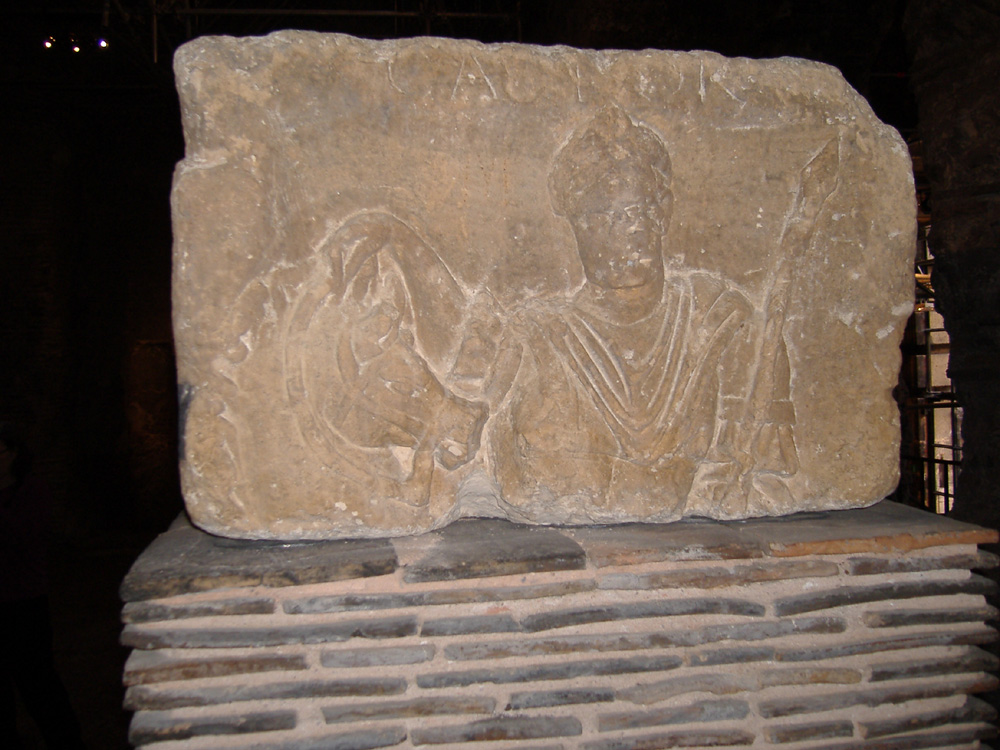
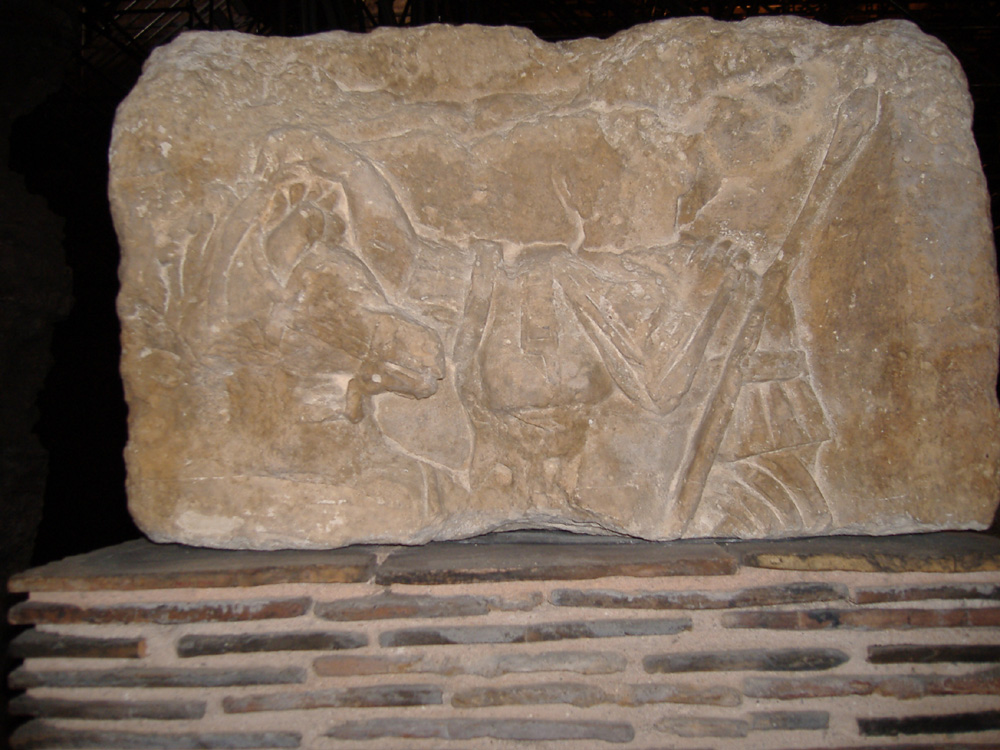
One intriguing image is on a pottery stamp from Corbridge (Ross, 1967, pl. 65a), which shows a helmeted god carrying a shield and leaning on a crooked club. A wheel is on the ground to his right (since this is a mold, in the formed version it would have been on his left). The helmet and shield may link him with Mars, who is a protector and agricultural god, and the club with the snake-killer Hercules. That the club is crooked may be an attempt to portray a lightning flash. We would therefore have a Taranis-Mars-Hercules, and a god who is a protector, agricultural, a slayer of serpents, and connected with lightning, accompanied by a wheel. One of the Dagda’s by-names is Roth, “Wheel,” and his club is so long it has to be supported by one (Cath Maige Tuired, Gray, 1982, 93). In Rome, Summanus, who was the god of nocturnal lightning, was offered bread in “the shape of a wheel” (Festus 474.17L; in Glinister, 2014, 219).
We have already seen how the wheel can be a sun symbol, and there are those, such as Miranda Green (see, for example, her 1986, 130-1), who identify the wheel found with the thunder god (and, indeed, all wheels) that way, and believe that its connection with the thunder god is as a celestial symbol. It must be remembered, however, that a symbol can have more than one meaning. I don’t see, however, why a sun would be an appropriate symbol for a god of the cloudy sky. More likely is that the wheel is a representation of thunder, which even today we describe as “rolling.” This seems to have been the Germanic concept as well; thunder in both Old English and Icelandic is referred to as “travelling or moving” (Turville-Petre), and thunder-gods often move in chariots.
There is a possible connection between columns and thunder gods. In Gaul (particularly eastern France and western Germany) and Britain we find the Jupiter columns. “Thurstable,” the name of a place in England, had the original meaning of “Thor’s Pillar” (Turville-Petre, G., 1962, 21; Turville-Petre, E. O. G., 1964, 99). Thor was the god of house pillars (Turville-Petre, 1964, 88). There is a Vedic festival named Indramahotsava, held in early August, which involves erecting a pole; it is “Indra’s feast” (Gonda 1980, 427; Kuiper, 1975, 111; Toffin, 1922, 80). Indra was also connected with the sacrificial pillar, the yūpa (Woodard, 2006, 95). The close connection between Odin and Yggdrasill (he hangs on it to gain the runes, his horse is tied to it) may be relevant; although Odin is not a thunder god, he is the chief one. In fact, perhaps it is being chief god, rather than being the thunder god, that makes the connection; the god of the pillar is the god of the axis mundi. Might “the pillars of Hercules” be connected here? There is certainly a myth explaining them, but the use of the word “pillar” to describe them is suggestive; other words could have been used.
Perúnъ was a god of truth, specifically of oaths. He was invoked in treaties; in one case it was said that oath-breakers, who had thereby become accursed by him, would be slain by their own weapons (Jakobson, 1969, 582; Turville-Petre, 1964, 96). Thor was also a god who enforced law (Davidson, 1969, 613). The enforcement of law by Perkʷū́nos is a natural outgrowth of his role of slaying forces of disorder.
Perkunas is described by Simon Grunau in the Prussian Chronicle (dating from c. 1520), (West, 2007, 240), as “an angry-looking middle-aged man with a fiery face and a dark crinkly beard. He spits fire, and hurls an axe or (less often) a hammer, which returns to his hand.” Perúnъ has a tawny (West, 2007, 242) or copper (Gimbutas, 1971, 165) beard. Indra also has a tawny beard (RV 10.23.4, in Macdonell, 1897, 55) as well as tawny hair (10.96.5, 8 in Macdonell, 1897, 55).
Indra’s arms are long and far-extended (Macdonell, 1897, 55), lining up nicely with “Lug of the Long Arm” (Rees & Rees, 1961, 52). The epithets likely refer to the two deities’ throwing ability.
The sacred animal of Perkʷū́nos is the bull, an animal of great power, rampant sexuality, and danger (For Perkunas, Gimbutas, 1973, 470.) Among the Romans, only Mars was offered a bull specified as fertile (Puhvel, 1978b, 360). The Umbrians sacrificed bull-calves to Mars Hodius (“The Bronze Tablets of Iguvium” I b 3; in Poultney, 1959, 162; Weiss, 2010, 248) and three bulls to Mars Grabovius (VI b 1, Weiss, 2010, 248, n. 7. Poultney (1959), 251, had previously translated this as “three oxen.”) Cato (On Agriculture, 83) relates a ritual for the health of cattle directed towards Mars Silvanus. Bulls are also not the only animals sacrificed to Mars in Rome; in Cato’s famous suovotaurilia prayer (On Agriculture, 141), he is offered a calf, a lamb, and a pig (probably a piglet).) Procopius (De Bellico Gothico 3.14) tells us that bulls were sacrificed to the Slavic thunder god, and, indeed, bulls were sacrificed to St. Elias, his Christian replacement, into modern times (Polomé, 983, 546) (although Elsie, 2001, 84, says oxen). In Armenia, a black bull was associated with the thunder god (Petrosyan 2011, 346). Black bulls were also offered to the Lithuanian and Hittite thunder gods (Petrosyan, 2011, 347). A plaque from Thrace with a horseman similar to the three-headed one depicts a bull sacrifice (Schiltz, 1987, 298). Indra eats many buffaloes (Macdonell, 1897, 56), and may take the form of a red bull (Hillebrandt, 1980 (1929), 132). His mother is identified as a heifer and he as a bull in RV 4.18.10. RV 1.171.5 calls him a “strong and terrible bull.” In RV 1.32.11, he is compared as a bull to the castrated steer Vṛtra, who he has just destroyed. In sacrifices to him, the dakṣiṇā (the gift to the priest) was a bull (Hillebrandt, 1980 (1929), 132). In the triple sacrifice, the sautrāmaṇi, of a ram, a bull, and a buck, the bull is sacrificed to him (Mallory and Adams, 1997, 138). Parjanya is sometimes called a bull, who fertilizes the earth (RV 5.83.1; Macdonell, 1897, 83). The hoof beats of a running bull suggest thunder. One of the Proto-Indo-European words for "bull," *wisontos, means "the one who urinates." The combination of bellowing and urination brings to mind the god of thunderstorms.
Some of his reflexes are connected with goats. An image of Thor described in the late 12th or early 13th century is seated in a chariot drawn by goats, which is how is described in the Haustlong as well (Turville-Petre, 1964, 81-2). He is even called “lord of goats” (Hvmiskviða 20, 31; Turville-Petre, 1964, 82). The Gallehus figure has a goat on a leash. The car of Perkunas is drawn by one or more (West, 2007, 240; Gimbutas, 1980, 165; Gimbutas, 1973, 466). A 16th century sacrifice to Percuno(s) included a goat (Turville-Petre, 1964, 97). The infant Zeus, who has acquired the thunder and lightning power of Perkʷū́nos is fed with goat’s milk. Zeus sits on a goat skin when he produces rain (Gimbutas, 1973, 471). There was a Roman festival of Jupiter at the Caprae Palus, “Marsh of the She-Goat” (Evans, 1974, 103). The Ossetes set up a pole with a black goat’s skin on it by the grave of someone who had been struck by lightning (Evans, 1974, 103, n. 2).
Finally, Indra was associated with rams; he is called one (RV 1.51.1, 1.52.1), or even takes the form of one (RV 8.2.40).
Bulls, goats, and rams are, of course, animals connected strongly with male sexuality and fertility.
It is probable that rituals in honor of Perkʷū́nos involved dancing. Mars and Hercules had their Salii. Zeus had his Kouretes, who drowned out his crying as a baby, thereby protecting him from Cronos, by dancing with spears and shields ( Apollodorus, 1.1.7, 1.1.7). Hesiod (Fragment 6, in Hesiod, 1937, 277) calls them “sportive dancers.” There were dances to Herakles celebrating his slaying of various monsters, especially Cerberus (Lonsdale, 1993, 272). Zeus himself is said to be a dancer (“The Epic Cycle” 5, in Hesiod, 1936, 481), and Perkons danced as well (Ogibenin, 1974, 33, n. 11). The Armenian Sanasar’s mother Covinar dances in the clouds (Petrosyan, 2017, 172). Indra and the Maruts were called nṛtu, “dancers” (Dumézil 1970a, 211).
It is certainly true that in the western Indo-European world there were dancers associated with military endeavors. In Livy, in Iberia they precede gladiatorial combat (21.41.3) and the onset of battle (38.17.4), and among the Gauls as they enter battle (38.17.4); the Germans also dance as they go into battle (Tacitus, Histories 5.17) (references in Hanibek, 2005, 22). As part of their training for adulthood initiation (that is, into a warrior’s status), Cretan adolescents were taught to dance (Bremmer, 1999, 44), as they were at Sparta Athenaeus (14). (On the other hand, girls were also taught to dance in their periods of initiation (Bremmer, 1999, 69), so this may not be significant. A poem of Socrates recorded by Athenaeus (14) says that those who are best in dance is best in war. It’s worth noting, however, that in Greece weapon dances were also performed in honor of Apollo and Artemis (Lonsdale, 1993, 73).
The Thunder God is a glutton. Thor in the land of giants downs three barrels of mead and the Dagda eats a cauldron full of eighty gallons of milk, eighty gallons of oats, eighty gallons of fat, goats, sheep, and pigs (“Cath Maige Tuired,” Gray, 1982, 89-92). Thor can eat two whole bulls (“Hymiskvitha” 15: Crawford, 2015, 94). On one occasion he ate an ox, eight salmon, “all the delicacies reserved for the women” at the feast, and drank three kegs of mead (“Thrymskvitha” 24: Crawford, 2015, 120). A statue of Thor which St. Olaf of Norway destroyed had been offered four loaves of bread a day; although Chaney (147, n. 133) seems to suggest that this was because of some significance of the number four, that’s still a lot of loaves for one god to eat in a day. According to Festus (358 L2; in Dumézil, 1970, 436), Hercules could be offered anything edible or drinkable.Plutarch (Roman Questions 18) describes Hercules as a huge eater. In the Greek Anthology 9.316, there are two gods at a border, Hermes and Herkales. Hermes says that if wild pears are offered to Herakles, he “bolts them down,” and if grapes are offered, Herakles doesn’t care if they are ripe or sour. Herakles he can eat two oxen at one sitting (Burkert, 1979, 96). At one of his sacrifices, the entire animal had to be eaten on the spot, including the skin (Dumézil, 1970a, 436-7). Eating was central to the festivals of Herakles (Burkert, 1979, 96), and Burkert writes “comedy has made him the glutton par excellence” (1979, 96). Images of him often shown him at banquets, either with family members or other deities (Jameson, 1994, 47). Indra can eat up to three hundred buffaloes (Keith, 1989, 124-5) and drinks more soma than he should. He is so much of a glutton that in RV 10.28.2 he has two stomachs.
There is an ancient connection between Perkʷū́nos and Dyḗus Ptḗr (Gamkrelidze and Ivanov, 1995, 694), (possibly pre-dating the rise of the social division seen in the ideology of the three functions), as gods of the stormy and of the sunny sky, respectively. This is well expressed in the comparison between their usual sacrificial victims, the unpredictable, passionate bull (the stormy sky), and the placid, rulable ox (the clear sky).
There is an interesting parallel between two myths told of Thor and of Indra. Loki has stolen Thor’s hammer and given it to the giants. To get it back, the two travel to the land of the giants, with Thor dressed as a woman. A comic tale follows, with Thor supposedly there to marry one of the giants. Indra, on the other hand, falls in love with an Asura. He goes to live among them, in the form of a woman among the women, and a man among the men (Macdonell, 1897, 57). The combination of taking a female form among Outsiders is interesting and suggestive, but we can’t go any further.
It is possible that being on horseback was a characteristic of Perkʷū́nos. As well as the Jupiter columns, there is an altar dedicated to Perúnъ (found at Peryn’, near Novgorod, where he is on horseback, and the Hittite Pirwa also rode a horse (Gamkrelidze and Ivanov, 1995, 474). The Roman horse sacrifice was dedicated to Mars, and the Vedic one originally to Indra. However, this remains only a possibility.
There is some question as to whether his name should be translated as “Striker” or “Oak God.” The *perkʷ- in his name may be that which is the root of “percussion,” or the source of words meaning "oak," perhaps because oaks were believed to be often struck by lightning (Gimbutas, 1973, 467; Polomé, 1983, 546). (This has, in fact, been shown to be the case in reality (Hillebrandt, 1980 (1929), 398-9)). The root has reflexes meaning “strike” in Lithuanian (perti), Slavic (prati), and Armenian (harkanem) (Gimbutas, 1973, 466, n. 1). In Latin (quercus) and Celtic (hercos), on the other hand, the meaning is “oak” and “oak forest,” respectively. Other descendants are linked with "mountain" (Gamkrelidze and Ivanov, 1995, 526-527), such as Hittite peruna and Sanskrit párvata, both meaning “mountain top” (Gimbutas, 1973, 466); this is also the case in the Gothic fairguni (Jakobson, 1972, 6). Maximus of Tyre provides the additional information that the Celts venerated oaks as a symbol of Zeus (Davidson, 1988, 23; Ross, 1967, 33). There was an oak grove dedicated to Thor at Dublin.
This complex of ideas – striking, lightning, oak, and mountain – identifies Perkʷū́nos with the axis mundi. This fits with his position as defender of truth; he is the support of the universe. The oak connection also emphasizes his strength, integrity, and tenacity. The root *dreu-, from which comes English "tree" and "true," formed the root for "oak" in some languages. Perkʷū́nos is hard, even stubborn. But stubbornness in defense of truth is a virtue.
References:
Anderson, Earl R. Father-Son Combat: An Indo-European Typescene and its Variations. Journal of Indo-European Studies 36:3 & 4 (Fall/Winter, 2008), 269-32.
Apollonius Rhodius. Argonautica. Translated by Seaton, R. C. Loeb Classical Library Volume 001. London, William Heinemann Ltd, 1912.
Apollodorus. Gods and Heroes of the Greeks. tr. Michael Simpson. Amherst, MA: University of Massachusetts Press, 1976.
Argonautica. Translated by Seaton, R. C. Loeb Classical Library Volume 001.
Beowulf. Heaney, Seamus (tr.). New York: W. W. Norton and Company, 2000.
Bryce, Trevor. Life and Society in Hittite World. Oxford: Oxford University Press, 2002.
Carpenter, Thomas A. Art and Myth in Ancient Greece. London: Thames and Hudson, 1991.
Chaney, William A. The Cult of Kingship in Anglo-Saxon England. The Transition from Paganism to Christianity. Berkeley: University of California Press, 1979.
Crawford, Jackson. The Poetic Edda. Stories of the Norse Gods and Heroes. Indianapolis: Hackett Publishing Company, 2015.
Davidson, H. R. Ellis. Myths and Symbols in Pagan Europe: Early Scandinavian and Celtic Religions. Syracuse, New York: Syracuse University Press, 1988.
DuBois, Thomas A. Nordic Religions in the Viking Age. Philadelphia: University of Pennsylvania Press, 1999.
Dumézil, Georges. Archaic Roman Religion. tr. Philip Krapp. Chicago: University of Chicago Press, 1970a (1966).
Duschesne-Guillemin, Jacques. The Religion of Ancient Iran. In Historia Religionum: Handbook for the History of Religions. ed. C. Jouco Bleeker. Leiden: E.J. Brill, 1969, 327-76.
Elsie, Robert. A Dictionary of Albanian Religion, Mythology, and Folk Culture. London: Hurst and Company, 2001.
Enright, Michael J. Lady with a Mead Cup: Ritual, Prophecy and Lordship in the European Warband from La Tène to the Viking Age. Portland, OR: Four Courts Press, 1996.
Evans, David. Dodona, Dodola, and Daedla. In Myth in Indo-European Antiquity. ed. Gerald James Larson, C. Scott Littleton, and Jaan Puhvel. Berkeley: University of California Press, 1974, 99-30.
Ford, Patrick K. (ed. and tr.) The Mabinogi and Other Medieval Welsh Tales. Los Angeles: University of California Press, 1977.
Gamkrelidze, Thomas V. and Ivanov, Vjaceslav V. Indo-European and the Indo-Europeans: A Reconstruction and Historical Analysis of a Proto-Language and a Proto-Culture. tr. Johanna Nichols. New York: Mounton de Gruyter, 1995.
Gimbutas, Marija. Perkunas/Perun: The Thunder God of the Balts and the Slavs. Journal of Indo-European Studies 1:4 (Winter, 1973), 466-478.
——The Slavs. New York: Praeger Publishers, 1971.
Glinister, Fay. Festus and Ritual Foodstuffs. Eruditio Antiqua 6 (2014), 215-27.
Gonda, J. Vedic Ritual: The Non-Solemn Rites. Leiden: E. J. Brill, 1980.
Graves, Robert. The Greek Myths. New York: Penguin Books, 1960.
Gray, Elizabeth A. (ed. and tr.) Cath Maige Tuired: The Second Battle of Mag Tuired. London: Irish Tracts Society, 1982.
Green, Miranda J. The Iconography and Archaeology of Romano-British Religion. Aufstieg und Niedergang der Römischen Welt II:18:1 (1986), 113-162.
Güterbock, Hans Gustav. Hittite Religion. Forgotten Religions. Ed. Vergilius Ferm. New York: The Philosophical Library, 1950.
Gwynn, Edward (ed. and tr.). The Metrical Dindsenchas. Todd Lecture Series IX-XI (1906 - 1924).
Hesiod, Homeric Hymns, Epic Cycle, Homerica. tr. Hugh G. Evelyn-White. Cambridge, MA: Harvard University Press, 1936.
Hillebrandt, Alfred. Vedic Mythology. tr. Sreeramula Rajeswara Sarma. Delhi: Motilal Banarsidass Publishers, 1980 (1929).
Hyginus. Fabulae. In Anthology of Classical Myth. Trzaskoma, M; R. Scott Smith, and Stephen Brunet (ed. and tr). Indianapolis: Hackett-Publishing Company, 2004.
Jakobson, Roman. The Slavic God Veles" and his Indo-European Cognates. Studi Linguistici in Onore di Vittore Pisani, vol. II. Bresciu, Italy: Paidepia Editrice, 1969, 579-99.
Jackson, Peter. Light from Distant Asterisks: Towards a Description of the Indo-European Religious Heritage. Numen 49 (2002), 61-101.
Jakobson, Roman. Slavic Gods and Demons. In Roman Jakobson: Selected Writings. Vol. VII: Contributions to Comparative Mythology. Studies in Linguistics and Philology. (1972). ed. Stephen Rudy. New York: Mouton Publishers, 1985, 3-11.
Jameson, Michael H. Theoxenia. In Ancient Greek Cult Practice from the Epigraphical Evidence, ed. Robin Hägg. Stockholm: Paul Åströms Förlag, 1994, 35-57.
Johnson, Van L. The Roman Origins of Our Calendar. Medford, MA: American Classical League, 1958.
Keith, Arthur Berriedale. The Religion and Philosophy of the Veda and the Upanishads. 2 vols. Delhi: Motilal Banarsidass Publisher, 1989 (1925).
Kershaw, Kris. The One-eyed God: Odin and the (Indo-)Germanic Männerbünde (Journal of Indo-European Studies Monograph No. 36). Washington, DC: Institute for the Study of Man, 2000.
Koch, John T. and Fernando Fernández Palacios. Some Epigraphic Comparanda Bearing on the ‘Pan-Celtic God’ Lugus. In Celtic Religions in the Roman Period. Personal, Local, and Global. ed. Ralph Haeussler and Anthony King. Aberystwyth: Casemate Academic, 2017, 37-55.
Kropje, Monika. Cosmology and Deities in Slovene Folk Narrative and Song Tradition. Studia Mythologica Slavica 6 (2003), 121-148..
Kuiper, F. B. J. The Basic Concept of Vedic Religion. History of Religions 15:2 (Nov., 1975), 107-120.
Laurinkienė, Nijolė. Transformations of the Lithuanian God Perkunas. Studia Mythologica Slavica 3 (2000), 149-58. .
Lindow, John. Addressing Thor. Scandinavian Studies 60:2 (1988), 119-36.
Lonsdale, Steven H. Dance and Ritual Play in Greek Religion. Baltimore: Johns Hopkins University Press, 1993.
MacCana, Proinsias. Celtic Religion. The Encyclopedia of Religion, v. 3. ed. Mircea Eliade. New York: MacMillan Publishing Co., 1987.
Macdonell, Arthur Anthony. Vedic Mythology. New York: Gordon Press, 1897 (reprinted 1974).
Macrobius. Saturnalia. ed. and tr. Robert A. Kaster. Cambridge, MA: Harvard University Press (Loeb Classical Library), 2011.
Maher, J. Peter. *Haekmon: "(Stone) Axe" and "Sky" in I/E Battle-Axe Culture. Journal of Indo-European Studies 1:4 (Winter, 1973), 441-462.
Mallory, J. P., and Adams, D. Q. (ed.). Encyclopedia of Indo-European Culture. Chicago: Fitzroy Dearborn Publishers, 1997.
Matasovic, Ranko. A Reader in Comparative Indo-European Mythology, 2009.
O'Flaherty, Wendy Doniger. Hindu Myths. Harmondsworth, UK: Penguin Books, 1975.
Ogibenin, B. L. Baltic Evidence and the Indo-Iranian Prayer. Journal of Indo-European Studies 3:1 (Spring, 1974), 23-45.
Pausanias. Description of Greece. tr. W. H. S. Jones and H. A. Ormerod. Cambridge, MA: Harvard University Press, 1926.
Petrosayan, Armen. Armenian Traditional Black Youths: the Earliest Sources. Journal of Indo-European Studies 39:3 & 4 (Fall/Winter, 2011), 342-54.
----Petrosyan, Armen. Armeno-Indian Epic Parallels. Journal of Indo-European Studies 45:1 & 2 (Spring/Summer, 2017), 172-86.
Pinsent, John. Roman Spirituality. In Classical Mediterranean Spirituality: Egyptian, Greek, Roman. ed. A. H. Armstrong. London: Routledge and Keegan Paul, 1986, 154-94.
Plutarch Plutarch's Lives. tr. Bernadotte Perrin. New York: G. P. Putnam's Sons, 1914.
Polomé, Edgar C. The Slavic Gods and the Indo-European Heritage. In Festschrift für Nikola R. Pribic. ed. Wolfgang Gesemann and Helmut Schaller. Munich: Hieronymus Verlag Neuried, 1983, 545-55.
Poultney, James Wilson, ed. and tr. The Bronze Tablets of Iguvium. Baltimore: American Philological Association, 1959.
Puhvel, Jaan. Victimal Hierarchies in Indo-European Animal Sacrifice. American Journal of Philology 99:3 (1978b), 354-362.
Radner, Joan. Lug, Balor, and the Landscape of Cultural Imperialism. In Crossed Paths: Methodological Approaches to the Celtic Aspect of the European Middle Ages. ed. Benjamin T. Hudson & Vickie Ziegler. New York: University Press of America, 1991, 141-52.
Rees, Alwyn; and Rees, Brinley. Celtic Heritage. New York: Thames and Hudson, 1961.
Ross, Anne. Pagan Celtic Britain. New York: Columbia University Press, 1967.
Russell, James R. Pre-Christian Armenian Religion. Aufstieg und Niedergang der Römischen Welt II:18.4 (1990), 2679-2692.
Sayers, William. Cerrce, an Archaic Epithet of the Dagda, Cernunnos and Conall Cernach. Journal of Indo-European Studies 16:3 & 4 (1982), 341-59.
Schiltz, Veronique (ed.). Gold of the Thracian Horsemen: Treasures from Bulgaria, 1987.
Scullard, H. H. Festivals and Ceremonies of the Roman Republic. Ithaca, NY: Cornell University Press, 1981.
Simek, Rudolf. Dictionary of Northern Mythology. tr. Angela Hall. Rochester, NY: D. S. Brewer, 1993.
Snorri Sturluson. Edda. tr. Anthony Faulkes. Rutland, VT: Charles F. Tuttle, 1987.
Stephany, Timoth J. Thor and Tyr: Revealing the Indo-European Sky God, 2006.
Stone, Alby. Hogbacks: Christian and Pagan Imagery on Viking Age Monuments. 3rd Stone 33 (Jan.-Mar., 1999), 16-20.
Toffin, Gérard. The Indra Jatra of Kathmandu as a Royal Festival: Past and Present. Contributions to Nepalese Studies, 19:1 (January, 1922), 73-92.
Tumėnas, Vytautas. The Common Attributes Between the Baltic God Perkūnas and his Antique Equivalents Jupiter and Zeus Mediterranean Archaeology and Archaeometry, 16:4 (2016), 359-67.
Turville-Petre, E. O. G. Thurstable. Nine Norse Studies. London: Viking Society for Northern Research, 1972. Orig. pub. in English and Medieval Studies Presented to J. R. R. Tolkien. ed. Norman Davis and C. L. Wrenn (1962), pp. 241 - 249.
Turville-Petre, E. O. G. Myth and Religion of the North: The Religion of Ancient Scandinavia. Westport, CT: Greenwood Press, 1964.
Vaitkevičius, Vykintas. Ancient Sacred Places in Lithuania: Crossroads of Geography, Archaeology and Folklore. Archaeologia Baltica 15:1 (June, 2013), 45-55.
Watkins, Calvert. How to Kill a Dragon. New York: Oxford University Press,1995.
Weiss, Michael. Language and Ritual in Sabellic Italy: The Ritual Complex of the Third and Fourth Tabulae Iguvinae. Boston: Brill, 2010.
---- An Italo-Celtic Divinity and a Common Sabellic Sound Change. Classical Antiquity 36:2 (2017), 370-89.
West, M. L. Indo-European Poetry and Myth. Oxford: Oxford University Press, 2007.
Whitney, William Dwight (tr.) Atharva Veda Sam˙hitā. rev. and ed. Charles Rockwell Lanman. Delhi: Motilal Banarsidass, 1905.
Woodard, Roger D. Indo-European Sacred Space. Chicago: University of Illinois Press, 2006.
York, Michael. Romulus and Remus, Mars and Quirinus. Journal of Indo-European Studies 16:1 & 2 (Spring/Summer, 1988), 153-172.
Zaehner, R. C. Postscript to Zurvan. Bulletin of the School of Oriental and African Studies 17:2 (1955), 232-249.
Zaroff, Roman. Some Aspects of Pre-Christian Baltic Religion. In New Researches on the Religion and Mythology of the Pagan Slavs, ed. Patrice Lajoye. Lisieux, France: Lingva, 2019, 183-219.
|

 Main Page